Feeding the Dinosaurs


Who doesn’t love dinosaurs? The images of well-known behemoths like Brontosaurus (arguably, “Apatosaurus” is a more proper name), T. rex, and Stegosaurus roaming about and eating everything in their sight has stirred the imagination of countless school kids, and many adults, too. I think it was during my second-grade year that I was introduced to dinosaurs in all of their splendid glory. Sure, I was fascinated by them, and had innumerable battles between my plastic toy dinos in our sandbox. Grrrrrrrrrr!!! Chomp, chomp.
Certainly, a lot has been made of the discovery and study of dinosaurs over the last two hundred years. In our lifetimes, many feature films (think: Jurassic Park) have portrayed actual, known dinosaurs in more-or-less realistic ways, helped out by the guidance of paleontologists who have studied them. (Check out this fun yet cheesy, less-than realistic, flick from many years ago: https://youtu.be/tVU4Hb67oWk?si=oR3Xqi0Ig5F-roDo ). Historically, it seems likely that humans have been finding dinosaur fossils for many centuries, but the first dino fossil scientifically described was of Megalosaurus, in 1824, by geologist William Buckland. The term Dinosaur, which literally means “terrible lizard”, was coined by the English scientist Richard Owen in 1842 for classification reasons, grouping such fossils as Megalosaurus, Hylaeosaurus, and Iguanodon into the Dinosauria. Interestingly, Owen was a renowned scientist and was a contemporary of – and fierce critic of – Charles Darwin. Also of note, dinosaurs were not technically lizards.
So, what’s your favorite dino?
When I was a kid, mine was Stegosaurus.

These days, after spending a considerable amount of time reflecting on this most important question, I’d have to say my favorite dinosaur is the hummingbird.

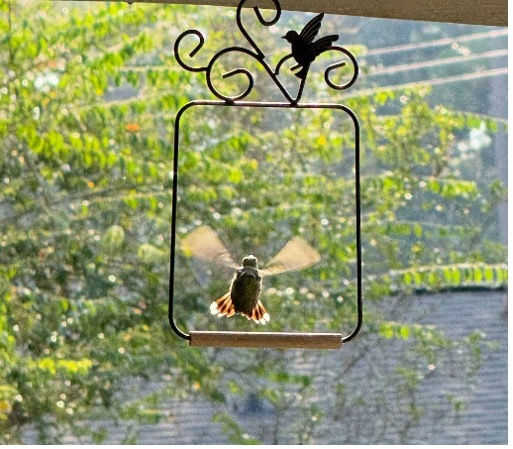
AHA! So, there’s an interesting backstory here.
Turns out that the classification of living things is kind of peculiar. Naturalists have been using classification systems, complete with scientific descriptions of species, for many, many years as a way to make sense of the natural world. However, these systems will always be problematic, in part because they are human constructs which force living things into categories, and Mother Nature just doesn’t work in categories. We still use them for convenience, but they will always be artificial constructs. The system most in use for the past couple of centuries was invented by Carl Linnaeus (1707–1778), who laid out a plan to organize all living things into hierarchical groupings that become ever more inclusive as one went up: related species are grouped into genera; related genera are grouped into orders; related orders are grouped into classes, etc. There are now more levels in this system than Linnaeus used, and these days we have a system that looks like this:
Domain
Kingdom
Phylum
Class
Order
Family
Genus
Species
Another hallmark of this classification system is the use of the last two levels, which taken together comprise an organism’s scientific name: Tyrannosaurus rex, Stegosaurus stenops, Homo sapiens.
But here’s the thing: while it’s a convenient way to organize living things, this system falls short in many ways. We don’t even have a good definition for species that can be applied across all of life, for crying out loud! Probably the most commonly used definition is something called the biological species concept, which goes something like this: “a group of organisms that interbreed to produce fertile offspring”. But…bacterial cells don’t have sex with one another (not in the conventional sense, anyhow), and plant populations commonly exist in geographic ranges that include small changes from one area to the next – resulting in incompatible fertilization prospects between plants from opposite ends of their ranges.
Kind of like this:
A – B – C – D – E – F – G – H – I – J
A x B? Yep.
C x D? Sure.
D x E? Good.
H x I? You bet.
You get the idea.
What about
A x J? NOPE! NOPE! NOPE!
And what about DINOSAURS??? Have you ever seen dinos having, well, relations??? Obviously, this definition cannot easily be applied to fossils.
More recently, systematists (those who specializes in the classification of living things) have realized that understanding relative degrees of evolutionary relatedness is a much better approach to classification than just assigning living things to groups according to, say, physical attributes alone. This understanding has led to a subcategory in evolutionary biology known as cladistics: grouping living things according to their shared evolutionary history.
So far as I know, Darwin was the first to represent living things in a “tree of life”, showing that all living things on Earth are related. From his Notebook B:

Cladograms (also called phylogenetic trees) are graphical representations of the evolutionary history of lineages. At every branch, there is a common ancestor to the subsequent groups that emerge. Thus, they show groupings of living things that are related through shared ancestry. In our case, we have a common ancestor that gave rise to both bonobos and chimpanzees, which means we are equally related to both. Further back in time, a common ancestor gave rise to gorillas as well as to the bonobo/chimp/human grouping. Notice that the circle I added comprises the Great Apes:

So, back to my favorite dinosaurs! A lot of publicity has been given to the extinction of dinos about 66 million years ago, caused by the collision of a giant asteroid with Earth as proposed by geologist Walter Alvarez, about 1980. Such a collision would have caused the ejection of tons and tons of debris into the atmosphere, leading to the collapse of ecosystems across the globe and a mass extinction event. (Check out the fascinating account of this discovery and the evidence Alvarez uncovered, including a layer rich in the element Iridium at the so-called K-T boundary, written by Alvarez himself: T. Rex and the Crater of Doom, 1997). One of the casualties of this mass extinction event: the group of animals we call dinosaurs.
Okay, hold on. Not all of the dinosaurs went extinct! One group of dinos survived – and we call them birds. Paleontologists have been studying the evolution of vertebrate groups, including birds, for decades, and there is now clear and overwhelming evidence that birds are an evolutionary lineage from a specific set of dinosaurs. (Be sure to check out this article for more information: https://www.scientificamerican.com/article/an-asteroid-extinguished-all-the-dinosaurs-except-for-birds-heres-why/).
We’ve learned a great deal about the evolution of birds. So much so, that the construction of cladograms is now possible. Like this, where Aves represents modern birds – including hummingbirds:

So, Aves shares a common ancestor with Ichthyornis, both of which share a common ancestor with Enantiornithes, etc. And all of these groups above the Dinosauria share a common ancestor with the Pterosaurs.
So what?
Notice that when I add a circle enclosing Dinosaurs and all of their descendants, look what happens:

This is why it doesn’t make any sense to think about birds in their own category. Instead, they are dinosaurs!
Hummingbirds are truly amazing animals. Weighing about as much as a penny, they double their body weight before migrating by adding fat reserves to fat bodies on their breasts. And some ruby-throated hummers are known to fly across the Gulf of Mexico – flying nonstop for 500 – 600 miles over 18-24 hours. There’s no place to stop and rest!
If you have a “bird feeder” in your back yard, you should stop calling it that and call it what it really is: a DINOSAUR FEEDER.